

The Dutch landscape of impact entrepreneurs
The Netherlands comprises over 100.000 companies that are active with different forms of sustainable entrepreneurship. Around 2.800 companies operate as impact entrepreneur and around 7.600 companies take part in initiatives around impact. Together, over 10.000 companies work on impact entrepreneurship.
An overview:
- 108.000 companies work on societal impact in any form
- 20.000 companies mention they support the Sustainable Development Goals (SDG’s)
- 13.700 organisations are active in over 100 impactprograms
- 2.815 impact first-companies put their societal mission central
- 47.000 companies are active in over 600 programs involving sustainability
- 13.000 companies are innovative in sustainable energy, circular economy or social impact
Over 5 times higher than average:
- number of jobs in companies that work on social impact, the SDG’s or sustainability
- share of scale-ups at companies that work on the SDG’s or sustainability
Almost 10 times higher than average:
- share of scale-ups at companies that work on social impact
For more information, read the impact agenda 2030.
Analysis
The Netherlands works on a sustainable economy in various ways. Companies work on specific solutions on circularity or social impact, embrace the SDG’s (Sustainable Development Goals) or work on other sustainable solutions. The government, knowledge institutions and societal organizations support these companies through a number of instruments and initiatives, such as subsidies, startup programs, networks, awards or certifications.
Innovatiespotter maps different organizations to get a better view of the state of impact entrepreneurship in the Netherlands. On one side the company landscape: with machine learning, we classify all Dutch companies on innovation and sustainability and classify them in 11 innovation themes, among which is social impact. On the other side we map the innovation ecosystem: the participants of over 2.000 initiatives such as subsidies, startup programs, networks and sustainability certifications.
This analysis contains 2 parts:
- Demand, supply and match
- Dutch hotspots
Together these two parts give a detailed overview of impact entrepreneurship in the Netherlands.
We analyse impact with three questions:
The demand
- Companies: How many companies are in this theme?
- Are they participating in the ecosystem?
- How many companies miss opportunaties?
The supply
- The innovation ecosystem: What does the ecosystem look like and what companies are reached?
- What relevant companies are being missed?
The match
- Companies and ecosystem: How well do supply and demand align?
- Do thematic initiatives in fact reach the innovative companies?
Datasets
To answer these questions, we have created and compared two datasets.
Dataset 1, Companies: Innovatiespotter classifies all Dutch companies on innovation and sustainability with machine learning. There are two selections:
- All Dutch companies (the basis)
- Innovative companies within the theme Impact: companies that work on thematic innovations.
Dataset 2, Innovation ecosystem: Innovatiespotter tracks over 2.000 innovation- and sustainabilty ecosystems and matches the participants to individual companies. Two selections are available:
- The entire innovation ecosystem: over 2.000 initiatives
- The thematic ecosystem: initiatives that focus primarily on impact
Impact
Social Impact (social innovation) focuses on challenges such as workforce participation, equal opportunities, health and wellbeing. Companies that innovate, develop products or services support an inclusive society.
The demand: impact companies
The analysis shows that 2.815 companies in the Netherlands work on social innovations (2025). Around 58% of those are also part of the innovation ecosystem (1.636 companies). Around 42% do not show participation in the ecosystem (1.179 companies).
There is a difference in company size:
- Companies active in the ecosystem: 64 employees on average
- Companies without visible participation: 42 employees on average
Companies in the ecosystem are over 1.5 times bigger.
The supply: the social innovation ecosysteem
Of the 2.000 researched initiatives, 103 are primarily focused on social innovations or societal impact:
- 42 networks, such as: Future Up, SDG Nederland and Social Enterprise
- 15 awards, such as Diversiteit in bedrijf en Social Enterprizes award
- 2 startupprograms Social grow sessions and Green PAC iLab
- 20 subsidies, such as: Actieplan Laaggeletterdheid/Tel Mee Met Taal and subsidieprogramma fonds bestrijding kinderarbeid.
- 24 other initiatives, such as: PSO Nederland, UN Global Compact Participant, Rubio Impact Ventures and B-corp Nederland
Together these 103 initiatives reach 7.600 participating companies. On macrolevel this seems relatively low. Moreover, the ecosystem is fragmented: 7.600 participants on 103 initiatives averages 74 participants per initiative.
The match: does the social ecosystem reach their target group?
Around 58% of the 2.815 innovative social impact companies is active in one of the 2.000 initiatives. If we look at just the 103 social initiatives, it’s around 30%: 847 companies. The 103 initiatives also reach companies outside the target group. Companies that work on both social innovations and take part in social initiatives, can be seen as frontrunners on social innovation.
The numbers
The table and graph below show numbers and percentages that answer the questions of the analysis.
- The reach of 103 social initiatives in all companies,
- The reach of all 2.000 initiatives in 2.815 innovative social impact companies,
- The reach of 103 social initiatives in 2.815 innovative social impact companies

Summary
Social impact companies: 2,815
Number of social initiatives: 103
Reach of the 103 social initiatives across all companies: 7,600
Of the 2,815 innovative social impact companies, 1,636 are reached through all 2,000 initiatives (58%)
Of the 2,815 innovative social impact companies, 847 are reached through the 103 social initiatives (30%)
1.179 innovative social impact companies (42%) are not active in the innovation ecosystem
Impact hotspots
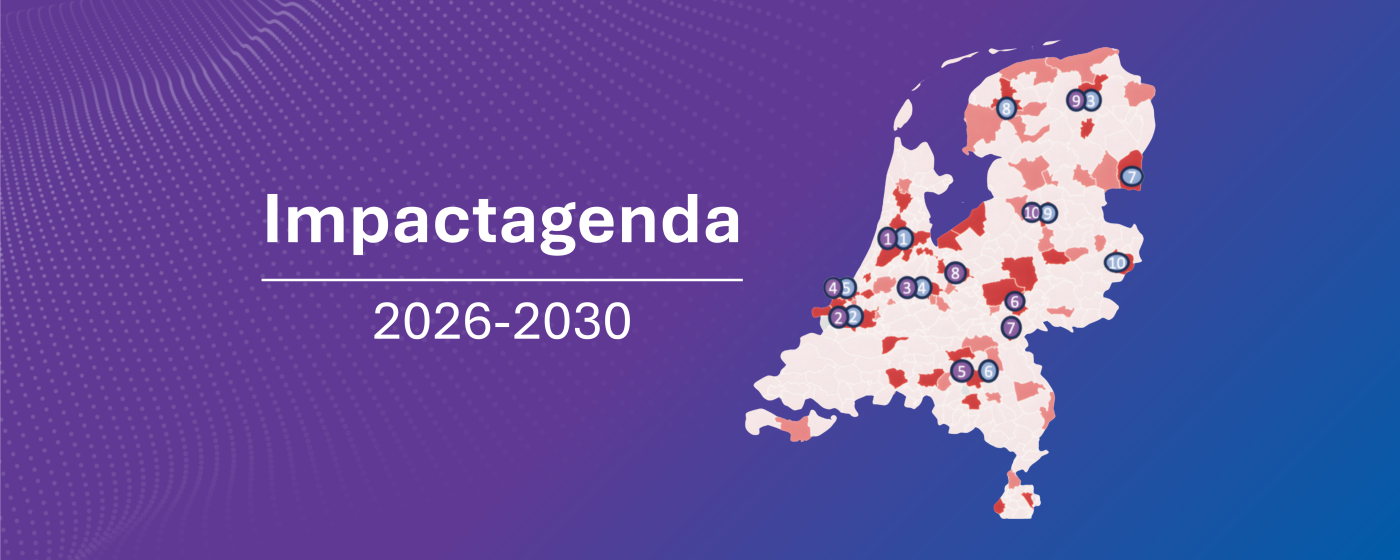
Social entrepreneurship, entrepreneurship aimed at creating societal impact, is growing. Examples include reintegration into employment, inclusive employment, poverty reduction, circular production and affordable healthcare. In some regions, social impact companies cluster, often around active networks and collaborations. This creates regional hotspots where entrepreneurship and collaboration reinforce each other.
The hotspots have been identified based on two factors:
- The presence of social impact companies
- The strength of the innovation ecosystem

Clusters are visible throughout the country:
- Randstad (Amsterdam, Rotterdam, Den Haag, Haarlemmermeer, Zaanstad):
The strongest concentration; several municipalities rank in the top 10 for both indicators; with initiatives such as:- Impact City,
- Sociale Inkopers Amsterdam and
- Social Impact Fonds Rotterdam.
- Utrecht-regio (Utrecht, Amersfoort): Utrecht ranks in the top 10 for both social impact companies and ecosystems, with initiatives including:
- Impact 030.
- Brabantse stedenrij (Eindhoven, ’s-Hertogenbosch, Breda, Tilburg, Meierijstad), with urban collaboration and regional networks such as:
- Sterk Brabant
- Gelderse corridor (Arnhem, Nijmegen, Ede, Apeldoorn): Arnhem and Nijmegen score high on ecosystems with initiatives such as:
- De Arnhemse Uitdaging,
- Impact Oost and
- Impact 024.
- Noord-Nederland (Groningen, Leeuwarden, Assen): Groningen is in the top 10 of both indicators, with networks such as:
- Impact Noord.
- Overijssel / Twente (Enschede, Zwolle, Deventer, Hengelo): Zwolle and Enschede score relatively high, with initiatives such as:
- Impact Noord en -Oost.
- Limburg (Maastricht, Heerlen), smaller but clear clusters such as:
- Brightlands-initiatives and
- ROM Limburg.
- Flevoland (Almere, Lelystad) Supported by for example:
- Horizon Flevoland
Impact companies
In the Netherlands, around 2.800 impact companies are active. The municipalities with the most impact companies are:
- Amsterdam
- Rotterdam
- Groningen
- Utrecht
- Den Haag
- Eindhoven
- Emmen
- Leeuwarden
- Zwolle
- Enschede
Impact programs and networks
In addition to companies, participation in impact programmes and networks plays a key role. 103 social-impact initiatives have been identified, involving over 7,600 participating companies. These include both national organisations such as Future Up, SDG Nederland, UN Global Compact, Social Enterprise NL and PSO, as well as regional initiatives.
The municipalities with the most participations of social impact programs are:
- Amsterdam, Strong representation in national programmes, including
many B Corp participants - Rotterdam, with initiatives such as:
- de Impactkaart Rijnmond
- de 010 Inclusie Award
- Utrecht, with Utrecht Impact 030
- The Hague, with:
- UN Global Compact
- de Social Club Den Haag
- Eindhoven, mostly national programs, such as PSO
- Arnhem, with:
- De Arnhemse Uitdaging
- AKSI Sociaal Inkopen
- Nijmegen, with initiatives such as:
- Impact 024
- het Inclusief Ondernemersnetwerk
- Amersfoort, with Impact033
- Groningen, with:
- Impact Noord
- het Platform Goed Inkopen
- Zwolle, with mostly national networks
The combination of impact companies and active ecosystems shows where impact entrepreneurship is strengthened through collaboration. These regions create an environment where knowledge sharing, collaboration and scaling up can take place more rapidly. This makes these hotspots relevant for organisations looking to invest in impact, find partners or stimulate regional development.